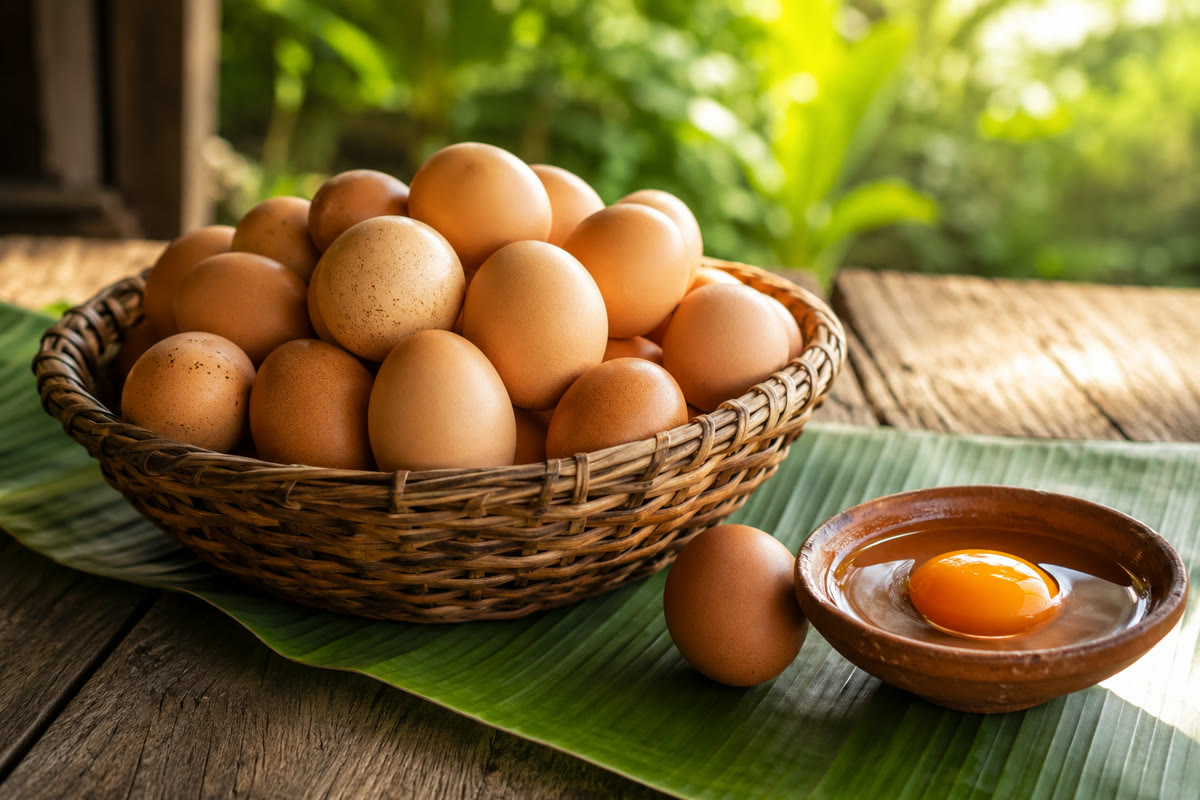
Crack one of our eggs next to a supermarket egg and the difference is not subtle. Ours sits deep orange, almost red at the edge. The other is pale, flat yellow. People assume this is a trick of the breed. It is not. It is diet, and nothing else.
Yolk colour comes from carotenoids — the same family of pigments that make carrots orange and spinach dark green. A hen cannot make them. She can only deposit what she eats, and she deposits it in the yolk.
What a free-range hen actually eats
A hen on open ground spends her day doing one thing: looking for food. She eats green leaf, seed heads, insects, worms, and whatever else she turns up scratching. Green leaf in particular is dense in lutein and zeaxanthin. Insects add more.
That diet is impossible to replicate in a cage. A caged hen eats a formulated ration, and the ration is designed for the lowest cost per egg — not for pigment. So the yolk comes out pale.
The part the industry does not advertise
Pale yolks are a commercial problem, because buyers read colour as quality. The industry's answer is not to change the diet. It is to add synthetic pigment to the feed — usually canthaxanthin or a marigold extract — and dose it against a colour fan until the yolk hits the target shade.
This works. A caged hen on pigmented feed produces an orange yolk. Which is exactly why colour on its own proves nothing, and why we would rather tell you how the bird lives than point at the yolk.
So what does it tell you here?
On our farm, colour is honest, because there is nothing added to the feed to make it so. Our hens are on open land with sunlight and clean water, and the yolk colour follows the season — a little deeper in the months when there is more green about, a little lighter in the dry stretch before the rains.
That variation is the tell. A yolk that is identical every single week has been standardised somewhere. Ours moves, because the ground moves.
What it means nutritionally
The carotenoids themselves are useful — lutein and zeaxanthin are the pigments concentrated in the human retina. But the more meaningful differences from a free-range diet are the ones you cannot see: more omega-3 fatty acids, more vitamin E, and more vitamin D in birds that spend the day in the sun.
None of that is exotic. It is what an egg has always been when the bird is allowed to be a bird.
Questions about any of this?
Ask us on WhatsApp